19Jun

Ahmedabad factories lose lakhs every summer through open doorways. See how PVC strip curtains cut energy loss by up to 80% — fast payback, zero downtime.

Ahmedabad in May is not a gentle experience.

Temperatures routinely cross 44°C. The air is dry, dusty, and relentless. Industrial areas like Naroda, Vatva, Odhav, and Changodar sit in the heat without relief — and every factory doorway that stays open for forklift movement, truck loading, or worker access is essentially an open invitation for that heat to walk straight inside.

The cooling system responds. The compressor kicks harder. The electricity meter spins faster. And this cycle repeats — dozens of times a shift, every working day, from March through June and again during the pre-monsoon period.

Most Ahmedabad factory managers know their summer electricity bills are high. What they don't always calculate is how much of that cost is caused by unprotected doorways — and how quickly PVC strip curtains fix that.

The Ahmedabad Heat Problem Is Specific

This isn't general advice about industrial energy efficiency. Ahmedabad has a specific set of conditions that make unprotected doorways more costly here than in most other Indian cities.

The temperature differential between a conditioned factory interior and the outside environment in peak summer can reach 20°C or more. Physics does the rest — hot outside air rushes toward the cooler interior every time a doorway is open. The larger the differential, the faster the infiltration.

Ahmedabad's industrial belt also deals with heavy dust from road traffic, construction activity, and dry wind conditions. Every open doorway is a dust entry point — affecting product quality, worker health, and equipment longevity in ways that don't show up directly on the electricity bill but absolutely affect the bottom line.

And unlike coastal cities, where humidity at least keeps some particulates settled, Ahmedabad's dry summer air keeps fine dust suspended and mobile. An unprotected factory entry in Vatva or Naroda during a hot April afternoon is actively pulling that dust into the production environment.

Flexible PVC strip curtains address both problems at once — the heat and the dust — without slowing down operations by a single minute.

What PVC Strip Curtains Actually Do at a Hot Doorway

The strip curtain hangs above the doorway on a mounting rail. Overlapping vertical strips of clear or tinted PVC — each strip slightly wider than the one it overlaps — create a continuous physical barrier from rail to floor.

A forklift approaches. The strips part. The vehicle passes through. The strips fall back into place in under a second. The barrier is restored.

During that brief passage, some air exchanges between inside and outside. But compared to a door that stays open for the full duration of vehicle movement — or worse, stays propped open throughout a busy shift — the exposure time is a fraction. And flexible PVC strip curtains between door openings hold the thermal separation completely.

The result: the conditioning system isn't constantly fighting a wide-open doorway. It maintains the interior temperature with significantly less effort, which shows up directly in reduced electricity consumption.

The Energy Numbers for Ahmedabad Conditions

The energy case for PVC strip curtains in Ahmedabad is stronger than the industry average because of the extreme temperature differentials the city experiences.

Research on industrial doorway energy loss consistently shows that properly installed PVC strip curtains reduce heat infiltration through open doorways by 60% to 80% compared to unprotected openings. For air-conditioned production areas, that translates to 20% to 30% reduction in cooling-related electricity consumption.

For a mid-sized Ahmedabad factory with four to six high-traffic doorways running 12-hour shifts through a six-month hot season, this is not a marginal saving. Depending on the size of the conditioned area and the door frequency, the annual electricity saving can run from ₹1.5 lakh to ₹6 lakh.

The cost of installing PVC strip curtains across those doorways? Typically ₹15,000 to ₹50,000 for the complete installation, depending on door width and curtain grade. The payback in energy savings alone is often achieved within one summer season.

After that, every summer, the curtains in place are pure savings.

The Industries in Ahmedabad That Benefit Most

Pharmaceutical manufacturing — Ahmedabad and the surrounding area host one of India's largest concentrations of pharmaceutical plants. Clean production environments, HVAC-controlled zones, and hygiene separation between areas all benefit directly from PVC strip curtains at internal and external entry points. Dust control is as important as temperature here.

Chemical and dye manufacturing — Vatva's chemical industrial estate has specific contamination control requirements. Zone separation between production areas, containment of fumes, and temperature management in storage areas are all addressed by industrial PVC strip curtains.

Textile and garment factories — Ahmedabad's textile heritage means hundreds of facilities dealing with lint, fibre, and the specific challenge of maintaining consistent temperature in spinning and weaving areas, where heat affects both material quality and worker productivity.

Food processing and packaging — FSSAI compliance requirements for insect control and hygiene zone separation make PVC strip curtains a regulatory requirement as much as an energy solution. Amber anti-insect grade curtains at external entries, clear curtains at internal zone dividers.

Cold storage and dairy — Gujarat's dairy industry is significant, and cold storage in Ahmedabad's extreme heat requires every possible measure to maintain refrigeration efficiency. Polar-grade PVC strip curtains at cold room entries directly reduce compressor load during peak summer.

Engineering and auto component manufacturing — Odhav and Changodar's engineering clusters deal with heat from machining operations, compounding the already extreme outdoor temperatures. Zone separation between hot machining areas and assembly or quality control areas reduces the load on localised cooling.

Choosing the Right Grade for Ahmedabad's Conditions

This is where many buyers go wrong — they choose a curtain based on price rather than specification for the environment. In Ahmedabad's conditions, the wrong grade either underperforms or fails within a season.

UV stabilisation is non-negotiable. Ahmedabad's sun exposure is intense and prolonged. Standard PVC yellows, becomes brittle, and loses flexibility rapidly under direct and reflected sunlight. UV-stabilised flexible PVC strip curtains maintain clarity and flexibility for three to five years in Ahmedabad conditions. Non-UV-stabilised grades may crack or discolour within one summer.

Clear standard grade — for internal zone separators, dispatch areas, and doorways without direct sun exposure. Cost-effective, maintains visibility for safe forklift operation.

Ribbed / buffer grade — for high-traffic openings where forklifts and loaded trolleys pass through repeatedly. The raised ribs absorb impact across the strip face, extending service life significantly in Ahmedabad's busy factory environments.

Amber anti-insect grade — essential at external-facing entries for food processing and packaging. Ahmedabad's summer brings high insect pressure, particularly near organic material. The amber tint deters flying insects without compromising visibility.

Polar grade — for cold room and blast freezer entries. Standard clear PVC becomes brittle in sub-zero conditions. Polar grade stays flexible at -25°C.

Magnetic grade — for openings where the curtain must reseal completely between each passage. Embedded magnets pull the strips back together automatically. Particularly effective for cold rooms and pharmaceutical zone entries where partial sealing loses the benefit.

Installation — Quicker Than Most Factories Expect

A complete doorway of PVC strip curtains Ahmedabad factories typically install in two to four hours.

The aluminium or stainless steel mounting rail fixes above the door frame with anchor bolts. Individual strips hang from clip hooks on the rail, which also makes individual strip replacement simple when one gets damaged by a forklift without replacing the whole system. Overlap between adjacent strips is adjustable based on the required seal tightness.

No electrical work. No structural changes. No specialist contractor for a standard installation. The strips can be wiped clean with a damp cloth. If one strip gets damaged beyond cleaning, only that strip needs replacing — not the entire curtain.

For factories operating multiple shifts, installation can typically be completed during a maintenance window or non-production period without affecting output schedules.

Cronax Industries — PVC Strip Curtains Built for Ahmedabad

For Ahmedabad factories looking for a supplier who understands local conditions — the temperature extremes, the dust levels, the compliance requirements, and the usage intensity of busy industrial facilities — Cronax Industries is the right conversation to start.

Cronax Industries supplies PVC strip curtains Ahmedabad across the full range of grades: UV-stabilised clear, ribbed, polar, amber anti-insect, magnetic, anti-static, and welding grade — all manufactured to consistent thickness standards and fire-retardant certified.

Their strips are specifically selected for Ahmedabad's operating conditions. UV stabilisation is standard, not an upgrade. Material consistency across production batches means replacement strips match the original installation in clarity and flexibility — critical for facilities maintaining specific visibility or hygiene standards.

As a supplier with deep knowledge of Ahmedabad's industrial sectors — pharmaceutical, chemical, textile, food processing, cold chain — Cronax helps buyers specify the right grade, overlap, width, and mounting hardware for each doorway rather than applying a one-size solution. A pharmaceutical zone entry in Naroda needs a different specification from a loading dock in Vatva or a cold room in Odhav. Cronax gets this distinction.

For facilities managing multiple entry points across a large plant, consistent supply quality across reorders means the curtains installed in year two match the performance of those installed at commissioning. That consistency matters more than most buyers realise until they've dealt with a supplier who can't maintain it.

The Simple Case for Acting Before Next Summer

If your Ahmedabad factory has unprotected doorways that stay open during production — loading bays, zone entry points, external vehicle entries — every summer you delay is another season of paying for energy that's walking out through those openings.

The fix is not complex. It doesn't require downtime. It doesn't require capital approval for major equipment. PVC strip curtains are installed in hours and start reducing energy loss immediately.

In Ahmedabad's conditions — where the temperature differential is extreme, the dust is persistent, and the summer is long — the payback is faster here than almost anywhere else in India.

The question isn't whether to install them. It's whether to do it before next summer or after it.

Looking for PVC strip curtains in Ahmedabad for your factory, warehouse, or cold storage? Talk to Cronax Industries about the right grade and specification for your facility.
16May

ronax PVC strip curtains cut cold room electricity costs by up to 30%, block insects, control dust, and seal loading docks. Polar grade, anti-insect & heavy-duty variants available.


Nobody talks about PVC strip curtains at industry conferences. There are no glossy product launches. No one is getting excited about a plastic strip hanging in a doorway.

And yet — walk into any well-run cold storage facility, food processing plant, or busy warehouse in India, and you will almost certainly find them. 

Because the people running those facilities have done the maths, they know what an open doorway costs them every single day. And they found the cheapest, simplest fix available.

That fix is a Cronax PVC strip curtain.

What It Is and How It Works

Overlapping vertical strips of PVC plastic, clipped onto a rail above a doorway, hang to the floor. That is the whole product.

You walk through — or drive a forklift through — the strips part, and they fall back into place behind you. No button to press. No door to open or close. No motor, no electricity, no moving parts. The barrier is just always there.

That simplicity is the point. A door that has to be opened and closed gets left open. A PVC strip curtain never does.

What an Open Doorway Actually Costs You

Most warehouse managers think about open doorways as a convenience feature, not a cost centre. That changes quickly when someone sits down and calculates it.

In summer, India's outdoor temperatures hit 40 to 45 degrees regularly. If your warehouse runs air conditioning — or your cold room runs at minus 18 — every unobstructed opening is actively working against your refrigeration or HVAC system. Warm air pours in. Conditioned air bleeds out. Your compressor or AHU compensates by running harder, longer, and more expensively.

In a cold storage facility where the door cycles 100 times a shift, that is not a minor inefficiency. It is a structural drain on your electricity budget that recurs every single day.

Insects are the other problem nobody wants to talk about until an FSSAI inspector points it out. A single fly in a food processing area is a compliance finding. Rodents in a warehouse can write off an entire pallet load. Open doorways are how they get in — and a strip curtain is the most passive, lowest-maintenance way to keep them out.

Dust, noise, fumes, and safety at forklift-pedestrian crossing points are all secondary problems that strip curtains address without any additional investment. But energy and pest control are where most facilities feel the impact first.

Cold Storage Specifically — This Is Where the Numbers Get Serious

Standard PVC strip curtains work well in ambient and air-conditioned environments. Cold rooms are a different situation entirely.

The temperature differential between a minus-18 cold room and a 35-degree loading area is 53 degrees. Every door cycle — even a fast one — dumps a pulse of warm, humid air into that cold room. The refrigeration system has to work to pull that temperature back down. Over a 16-hour operating day with 120 door cycles, the cumulative load on the compressor is substantial.

Standard PVC also goes brittle in sub-zero conditions. It cracks. It loses its seal. It becomes a problem rather than a solution.

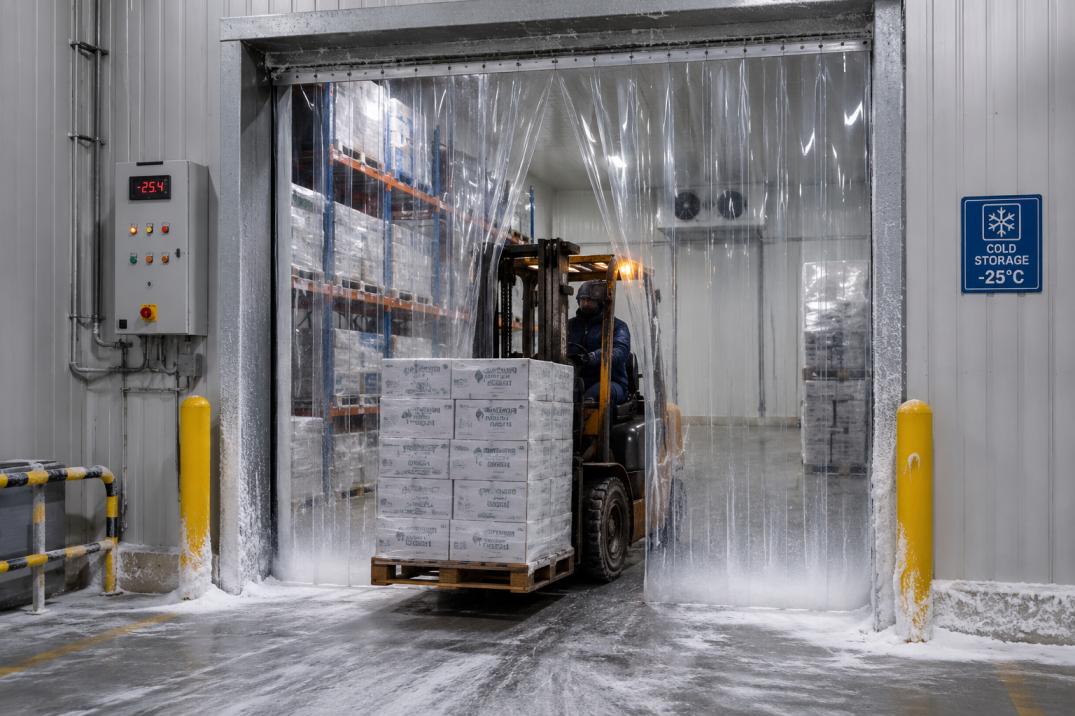
Cronax polar-grade PVC strip curtains are formulated to stay flexible down to minus 25 degrees Celsius. They hang in the doorway through every shift, every day, sealing passively after every pass without any intervention from your team.

The effect on compressor running time is measurable from the first month. Cold storage facilities in India that install polar-grade strip curtains consistently report electricity savings of 20 to 30% on cold room operating costs. For a facility running multiple cold rooms around the clock, that is a significant annual number — arriving from a product that typically costs a fraction of one month's energy saving.

A Real Facility, Real Numbers

A seafood cold storage unit on India's coast. Primary storage at minus 18. One access point. About 120 forklift cycles per day across two shifts.

Before the curtains: door opens fully for every forklift pass. Ambient air at 35 degrees enters each time. Compressor runs at near-continuous load. Ice forms around the door frame every few weeks and needs clearing. Electricity costs are high and predictable.

After Cronax polar-grade strip curtains, forklifts pass through without the door opening. The curtain reseals after each pass. Compressor duty cycle drops. Ice formation at the frame reduces sharply. Electricity consumption for the room falls by an estimated 25 to 30%.

The curtains paid for themselves in the first few weeks. Every month since has been pure savings.

Which Curtain for Which Situation

Cronax makes seven distinct types — because ambient warehouses, cold rooms, food processing areas, and electronics facilities all have different requirements.

Standard transparent — the default for warehouses, loading docks, and factory floor partitions. Clear PVC, full visibility, effective thermal and dust barrier. Works wherever the environment is ambient and the main requirement is a passive barrier.

Polar grade — cold rooms and freezer facilities only. Stays flexible at minus 25. Standard PVC cracks in sub-zero conditions — do not use it here.

Anti-insect amber yellow — food processing, commercial kitchens, packaging areas. The amber colour blocks the UV wavelengths that attract flies. A practical first line of defence in any FSSAI-regulated environment.

Anti-static (ESD) — electronics manufacturing, semiconductor facilities. Safely dissipates electrostatic charge before it reaches sensitive components.

Welding grade — opaque or tinted strips that block UV radiation and sparks from welding operations. Protects adjacent workers without restricting workshop access.

Fire retardant — high-risk industrial zones where fire regulations require a physical barrier between areas with different fire classifications.

Heavy duty — thicker material for zones where forklifts and heavy equipment pass through dozens of times per shift. Standard strips wear faster under constant contact. Heavy-duty lasts significantly longer in those conditions, and the slightly higher upfront cost is recovered in fewer replacements.

Picking the Right One Without Overcomplicating It

Three questions cover most decisions:

What is the temperature? Ambient or air-conditioned — standard PVC. Sub-zero — polar grade, no exceptions.

What is passing through? Pedestrians and light trolleys — standard thickness is fine. Forklifts passing through dozens of times per shift — go heavy-duty.

What is the hygiene context? Food or pharmaceutical — anti-insect amber or food-grade certified clear PVC with the appropriate FSSAI material documentation.

Opening dimensions matter too. For anything wider than two metres, the overlap between strips needs to be specified correctly to maintain a functional seal. Cronax manufactures to your exact opening dimensions — not from a standard roll trimmed to approximate fit.

Installation Takes Less Time Than You Think

Mount the rail above the opening. Clip in the strips at the specified overlap. Done. No specialist tools, no structural work, no production downtime.

If a strip gets damaged or wears out — and in high-traffic zones, individual strips do wear faster than others — you pull out the worn strip and clip in a replacement. The rest of the curtain stays in place. The doorway stays operational. The whole swap takes minutes.

Cleaning is a wipe with a damp cloth. That is genuinely all the maintenance these things need.

Where Cronax Strip Curtains Get Installed

Cold storage and food processing — the highest ROI of any sector. Energy savings on refrigeration, FSSAI compliance support, insect exclusion, and reduced cleaning frequency all arrive together.

Warehousing and logistics — dust control at loading docks, temperature zone separation, pest exclusion, forklift-pedestrian safety at internal partitions.

Pharmaceutical storage and manufacturing — humidity and contamination control between GDP and GMP zones, temperature separation in climate-sensitive storage areas.

Automotive workshops — paint fumes, welding sparks, and sanding dust are contained within specific bays without blocking vehicle movement between them.

Commercial kitchens — kitchen heat stays in the kitchen. Insects stay out of the kitchen. FSSAI compliance becomes easier to maintain consistently.

Textile manufacturing — lint and dust are contained within production zones, and temperature separation in air-conditioned cutting and finishing areas where fabric quality is sensitive to humidity.

Questions That Come Up Most Often

How long do they last?

Standard curtains in normal warehouse conditions: three to five years before individual strips need replacing. Heavy-duty variants last longer under constant forklift contact. Polar-grade curtains in cold rooms: two to four years, depending on temperature differential and daily cycle frequency. You replace individual strips as they wear — never the whole curtain at once.

Will my forklift tear them?

Under normal operating conditions, no. The strips flex around the mast and forks and return to position. If your forklifts carry wide loads that extend significantly beyond the mast, Cronax will specify the right strip thickness and overlap for your equipment when you provide details.

Can they go outdoors?

Yes, with UV-stabilised material. Standard PVC degrades faster under direct sunlight and outdoor temperature swings. Cronax makes UV-stabilised variants for loading dock canopies, outdoor entrance aprons, and semi-open industrial sheds.

What do I actually save on cold room electricity?

Indian cold storage facilities consistently report 20 to 30% reductions in cold room electricity costs after installing polar-grade strip curtains. The exact figure depends on your temperature differential, daily cycle count, and refrigeration system efficiency. For a multi-room facility operating around the clock, the annual savings are worth calculating before dismissing the upfront cost.

Do they work in very dusty environments?

Yes — heavier strips with wider overlap work better under the air pressure that dusty, open-sided industrial environments generate. Grain stores and construction material warehouses need a different specification than a clean warehouse. Tell Cronax about your environment, and they will get the specification right.

Are they FSSAI compliant?

Cronax manufactures food-grade PVC strip curtains using materials that meet food contact safety standards. Material certification is supplied with the product for FSSAI-regulated facilities. Mention the regulatory context when you enquire, so the right grade is specified and the paperwork comes with it.

One strip is damaged. Do I need to replace everything?

No. Each strip clips onto the rail independently. Pull out the damaged one, clip in a replacement, done. Cronax supplies replacement strips in all standard thicknesses and widths.

How fast can Cronax supply and install?

Standard sizes move quickly. Custom dimensions take longer depending on current production schedules. Cronax installs across India — timelines are confirmed based on your location and specification when you get in touch.

Worth Saying Plainly

PVC strip curtains are not exciting. They do not require a capital expenditure approval process. They do not need a maintenance contract. They do not need a technician to show up when something goes wrong.

They just hang there and work — cutting your energy costs, keeping insects out, containing dust, and separating environments that should not mix — every shift, every day, for years.

For cold storage facilities specifically, the electricity saving alone usually covers the cost within the first month. Everything after that is money back in the operation.

Cronax makes the widest range in India — standard transparent, polar grade, anti-insect, anti-static, welding grade, fire retardant, and heavy duty — all manufactured to your exact opening dimensions, all backed by after-sales support that does not disappear after installation.

If your facility has doorways, loading docks, or internal partitions where temperature, dust, insects, or contamination are costing you money — this is the fix. It is not complicated. It is not expensive. It works.

Get in touch with Cronax Industries and tell us about your openings. We will tell you exactly what you need and what you stand to save.

29Jan

Learn how plastic curtains, PVC strip curtains, and plastic door curtains improve hygiene, temperature control, and workflow efficiency in food industry facilities across India.


The food industry is one of the most sensitive sectors when it comes to hygiene and contamination control. Even minor dust, pests, or temperature variations can impact product quality and safety. This is why many food processing facilities are now investing in plastic curtains, also known as PVC strip curtains or plastic door curtains, to maintain a clean and controlled environment.

In cities like Bangalore, Pune, and Mumbai, where food processing units, cold storage facilities, and warehouses operate at large scale, plastic curtains have become an essential part of everyday operations.

What Are Plastic Curtains?

Plastic curtains are made from flexible, transparent PVC sheets arranged in overlapping strips. They are commonly installed in doorways or partition openings to create a barrier without restricting movement. Unlike traditional doors, these curtains allow forklifts, workers, and trolleys to pass through easily, while still maintaining a hygienic and temperature-controlled environment.

Also known as PVC strip curtains or strip curtains, these systems are widely used in industrial spaces where frequent access and hygiene are equally important.

Why the Food Industry Uses Plastic Curtains

Food processing and storage areas require strict hygiene standards. Plastic curtains help achieve this by:

  1. Maintaining Temperature Control
    Many food facilities in Bangalore and Mumbai handle perishable products like dairy, meat, and frozen goods. Open doors can lead to significant temperature fluctuations, which can spoil products. Plastic door curtains help maintain stable temperatures, reducing energy costs and preserving product quality.
  2. Preventing Dust and Contaminants
    Kitchens, production lines, and storage areas are susceptible to dust, smoke, and airborne particles. PVC strip curtains act as a physical barrier that prevents contaminants from entering critical areas, helping maintain cleanliness and safety.
  3. Reducing Pest Entry
    Flies, insects, and rodents are common challenges in food industries. Plastic curtains make it harder for pests to access production areas, supporting hygiene compliance and reducing contamination risks.
  4. Facilitating Workflow Efficiency
    Unlike solid doors, plastic strip curtains allow uninterrupted movement. Workers, trolleys, and forklifts can pass freely without the need to constantly open or close a door. This makes operations faster and smoother, especially in busy food production facilities.

Types of Plastic Curtains Used in Food Industry

There are several types of PVC strip curtains designed for different applications:

  • Transparent Plastic Curtains
    Allow visibility while maintaining hygiene and temperature control. Perfect for areas where monitoring operations is important.
  • Colored or Coded Strips
    Used to indicate restricted zones or separate different workflow areas.
  • Heavy-Duty Industrial Strip Curtains
    Suitable for large warehouses or cold storage units where forklifts and heavy machinery move frequently.

Food industries often work with PVC strip curtain manufacturers or suppliers to customize curtain thickness, width, and overlap according to their operational requirements.

Practical Applications in Indian Cities

1. Food Processing Units in Bangalore

Many food processing facilities in Bangalore install plastic door curtains at entry points, between storage zones, and near cold rooms. These curtains help maintain clean environments while allowing rapid movement of staff and trolleys.

2. Cold Storage Warehouses in Pune

Cold storage facilities use PVC strip curtains to prevent temperature loss when trucks or forklifts enter loading bays. This reduces energy consumption and preserves frozen goods.

3. Food Packaging Facilities in Mumbai

Plastic curtains in packaging areas prevent dust and particles from contaminating packaged food. They also help separate high-risk zones from common areas without slowing operations.

Benefits of Using Plastic Curtains in Food Industry

  • Cost-Effective: Compared to automatic doors or high-speed roll-up doors, plastic curtains are affordable and require minimal maintenance.
  • Durable: High-quality PVC strips can withstand daily industrial use without tearing or warping.
  • Easy to Install: Plastic curtains can be quickly mounted in new or existing facilities with minimal disruption.
  • Hygienic: Easy-to-clean PVC strips prevent microbial growth and maintain compliance with food safety standards.
  • Energy Efficient: Helps reduce electricity costs in temperature-controlled environments like cold storage or refrigerated rooms.

Choosing the Right PVC Strip Curtain Supplier

Selecting the right plastic curtain manufacturer or supplier is essential for ensuring quality, durability, and compliance with food industry standards. Factors to consider include:

  • Thickness and width of strips
  • Transparency for visibility
  • Customization options for height and overlap
  • Easy maintenance and cleaning procedures

In India, companies like Cronax Industries are known for supplying PVC strip curtains and plastic door curtains suitable for food industry applications, helping facilities maintain hygiene and operational efficiency.

Conclusion

Plastic curtains, including PVC strip curtains and plastic door curtains, are an essential investment for modern food industries in India. They create a hygienic, temperature-controlled environment while allowing free movement of personnel and equipment. Whether it’s a cold storage facility in Pune, a processing unit in Bangalore, or a packaging plant in Mumbai, plastic curtains offer an affordable, efficient, and practical solution for contamination control and workflow efficiency.

For food industry operations, investing in high-quality plastic curtains not only improves hygiene but also enhances productivity and reduces energy costs—making them a smart choice for facilities across India.

02Dec

Discover why PVC strip curtains are durable, energy-saving, and budget-friendly for warehouses, cold storage, food units, and cleanrooms. Learn benefits, uses & tips.

In today’s fast-moving industrial world, every business—whether it's a warehouse, manufacturing unit, commercial kitchen, cold storage, or cleanroom—looks for solutions that offer high performance, durability, and cost savings. One product that ticks all these boxes is the PVC Strip Curtain.PVC Strip Curtains may look simple, but they play a huge role in improving hygiene, controlling temperature, reducing energy loss, and creating safer working environments. Because of their long lifespan and low maintenance needs, they have become a preferred choice for businesses across India.

Let’s look at why PVC Strip Curtains are cost-effective and built to last, and why so many industries choose them over traditional doors.

What Are PVC Strip Curtains?

PVC Strip Curtains are made from flexible PVC strips that overlap and form a barrier. Workers, forklifts, trolleys, or materials can move through them without having to manually open or close a door.

They are widely used across:

  • Warehouses
  • Factories
  • Food processing units
  • Cold storage and refrigeration areas
  • Cleanrooms
  • Supermarkets
  • Hospitals
  • Loading docks
  • Packaging units

A reliable PVC strip curtain manufacturer offers them in different thicknesses, sizes, and temperature grades depending on the industry.

Why PVC Strip Curtains Are Cost-Effective

PVC Strip Curtains help businesses save money in many ways. Here’s how:

1. Lower Energy Bills

Temperature loss is one of the biggest challenges for cold rooms, AC rooms, and food storage areas.

PVC Strip Curtains work like an invisible shield, keeping warm air out and cold air inside. 

Because they:

  • Reduce temperature exchange
  • Minimize AC/heater load
  • Maintain consistent room temperature

Businesses benefit from noticeably lower electricity bills. Over time, this saving alone makes PVC strip curtains extremely cost-effective.

2. No Power Required to Function

Unlike automatic doors, high-speed doors, or shutters, PVC strip curtains do not require any electricity to work.

They function manually—people or vehicles simply walk or drive through them.

This means:

  • Zero electricity cost
  • Zero automation repair cost
  • No need for sensors or motors

This makes PVC Strip Curtains one of the most budget-friendly industrial barriers.

3. Low Installation Cost

Installation is simple, quick, and inexpensive. Most curtains require:

  • A mounting frame
  • Hanging channels
  • Pre-cut PVC strips

A trusted PVC strip curtain supplier will install them within hours, without halting your operations. No heavy equipment or complex process is needed.

4. Easy Maintenance & Low Replacement Cost

PVC Strip Curtains require almost no maintenance.

You can clean them with:

  • Soap water
  • Mild disinfectant
  • Clean cloth

If one strip gets damaged, you don’t have to replace the whole curtain—just change the affected strip. This saves time and money compared to traditional doors.

5. Long Lifespan

Good-quality PVC curtains made by reliable PVC strip curtain manufacturers in India last 3 to 5 years, even in heavy-use areas.

Their durability comes from:

  • High-quality PVC material
  • UV resistance
  • Temperature resistance
  • Flexibility
  • Tear resistance

Because they last long and need fewer replacements, they offer excellent value for money.

6. Reduce Cleaning & Housekeeping Costs

By blocking dust, insects, and outdoor pollution, PVC strip curtains help keep the workspace cleaner.

This reduces:

  • Cleaning frequency
  • Labor cost
  • Sanitization expenses

In industries such as food processing and pharmaceuticals, this is a huge advantage.

7. Cost-Effective Compared to Traditional Doors

Traditional doors cost more because of:

  • High manufacturing cost
  • Hinges and handles
  • Regular repairs
  • Repainting
  • Rust issues
  • Manual opening/closing time
  • Increased cooling loss

PVC strip curtains solve all these problems at a much lower cost.

Why PVC Strip Curtains Are Built to Last

Cost-effectiveness is important, but durability is equally valuable. PVC strip curtains are designed to handle tough industrial conditions.

1. Made from High-Quality, Industrial-Grade PVC

The PVC material used is flexible yet strong. It can withstand:

  • Heavy traffic
  • Temperature changes
  • Continuous movement
  • Moisture
  • Chemicals

Premium-grade PVC ensures that the curtains remain durable in all demanding environments.

2. Temperature-Resistant for Cold Storage & Freezers

Cold rooms rely heavily on PVC strip curtains.

Freezer-grade PVC strips stay flexible even at:

  • –20°C
  • –25°C
  • –40°C

They do not crack or harden in freezing temperatures, making them perfect for cold-chain logistics and frozen food units.

3. Strong Resistance to Wear & Tear

Whether the curtain is used in a warehouse with forklifts or in a busy factory, the strips maintain their strength.

They don’t tear easily, and even if they do, individual strips are replaceable.

4. UV and Chemical Resistance

In industries dealing with chemicals, heat, or sunlight exposure, PVC strip curtains remain stable.

They do not discolor quickly or react with most chemicals.

5. Hygienic & Easy to Clean

PVC is naturally resistant to germs and bacteria. Because of its smooth surface, it is easy to disinfect.

This makes it ideal for:

  • Food industries
  • Pharma cleanrooms
  • Hospitals
  • Laboratories

Its hygienic property contributes to long-lasting performance.

6. Rust-Free and Water-Resistant

Unlike metal doors, PVC does not corrode.

It stays in good condition even in:

  • Wet areas
  • Seafood processing units
  • Dairy facilities
  • Outdoor locations

Rustproof performance ensures a long life span with minimal upkeep.

7. Flexible Yet Tough

PVC strips bend easily when someone passes through, but return to their original position immediately.

This flexibility prevents damage and increases lifetime usage.

Industries That Benefit the Most

PVC Strip Curtains are popular in:

  • Logistics & warehouses
  • Food packaging units
  • Cold storage & freezer rooms
  • Retail stores & supermarkets
  • Pharma cleanrooms
  • Hospitals & labs
  • Chemical factories
  • Textile mills
  • Automotive workshops

Any workspace that needs hygiene, temperature control, or dust protection benefits from PVC curtains.

Final Thoughts

PVC Strip Curtains may look simple, but they offer powerful advantages. They help businesses save money, maintain hygiene, control temperature, reduce energy bills, and improve productivity. Their long lifespan, low maintenance, and durable build make them a smart investment for any industrial or commercial space.

Whether you’re running a warehouse, a cold storage unit, or a food processing facility, choosing the right PVC strip curtain manufacturer or supplier ensures better performance and long-lasting results.

PVC Strip Curtains are truly cost-effective and built to last—making them one of the most beneficial industrial products for modern workspaces.

I BUILT MY SITE FOR FREE USING